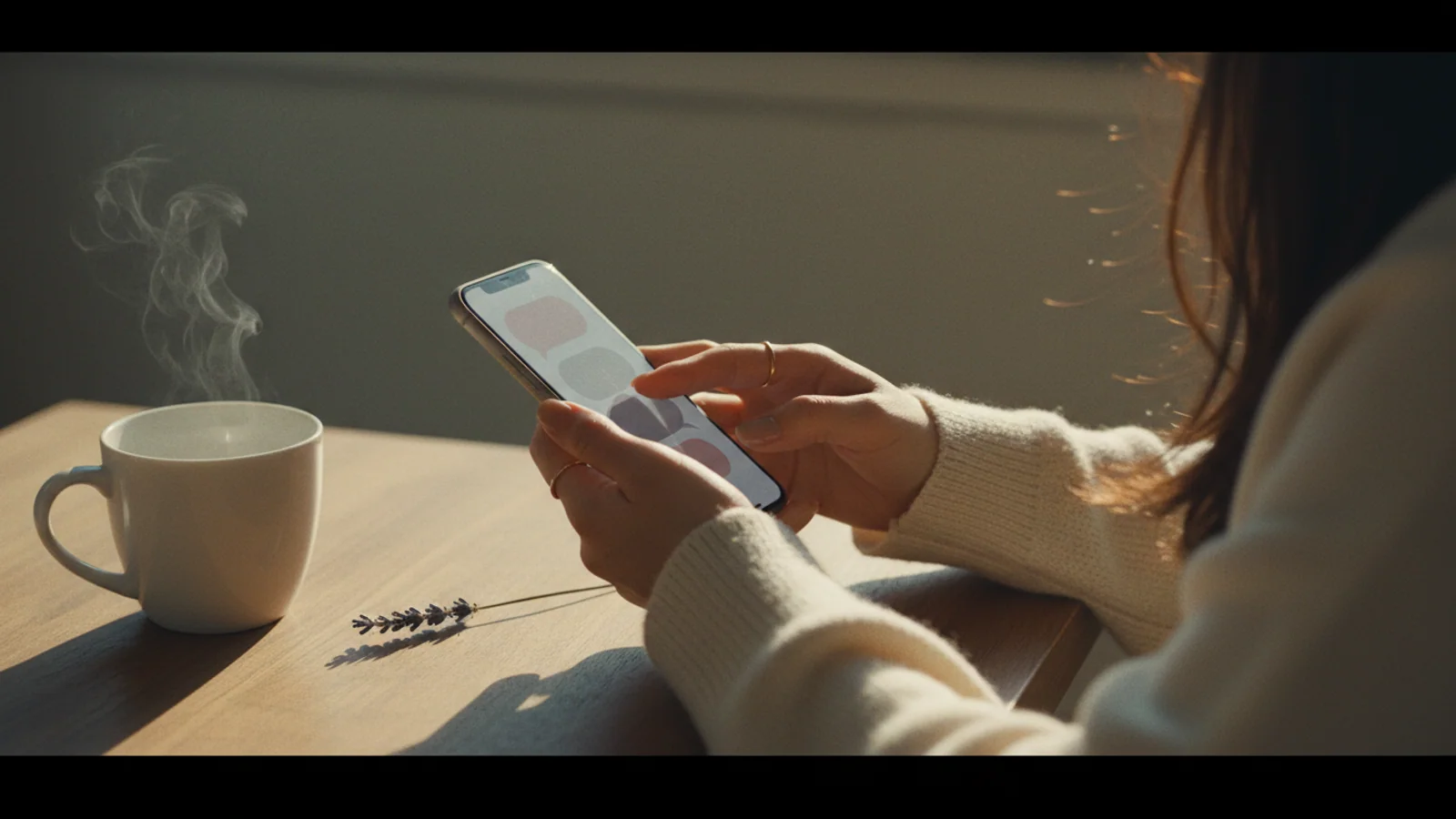
The first message is where most cross-cultural dating goes wrong. Not on the third date, not at the visa stage, not when the families meet. At message one. You spend three weeks building a profile, pay for a subscription, swipe through hundreds of women, find someone you actually want to talk to, and then you send “hi” and never hear back.
This guide pulls from the only large-scale public data we have on first messages, layers in what is actually different when the woman on the other end speaks English as a second language and grew up in Bangkok or Manila or Seoul, and shows you the patterns that consistently land replies. No alpha-male nonsense, no scripts to cut and paste.
If you are picking a platform first, our ranked Asian dating sites list is the place to start. Everything below assumes you have already matched with someone and are staring at an empty message box.
Why Most First Messages Fail
The OkCupid data team published the most-cited public study on first messages back when they ran their original blog. They analyzed more than 500,000 first contacts on the platform and broke down what predicted a reply. Three findings hold up more than a decade later and they are the foundation of everything else in this article.
First, netspeak kills replies. “Ur,” “u,” “wat,” “wanna,” “hit me up,” “sup,” and emoji-only openers all reduced response rates relative to plain English. The single biggest culprit was “ur,” which correlated with the steepest drop. This matters double when you are messaging women who learned English in school. They were taught proper grammar. Lazy English reads as low effort to a native speaker. To a second-language English speaker, it can be genuinely confusing.
Second, physical compliments backfire. “Sexy,” “beautiful,” “hot,” “cutie,” and “gorgeous” all underperformed. The exception was “pretty,” which OkCupid found performed slightly better than average, possibly because it reads as softer and less sexual. Compliments on what she said, posted, or wrote performed much better than compliments on how she looks. Every woman on a dating site has been told she is beautiful by dozens of men this week. None of them are remembered.
Third, length matters but not in the way most men think. Longer messages do correlate with higher reply rates, but the effect plateaus around 200 characters and the real driver is specificity. A two-sentence message that references something specific from her profile beats a five-paragraph message about yourself. Length without substance is just noise.
Hinge’s 2023 D.A.T.E. Report and Pew’s 2023 online dating findings back the same conclusion from different angles. Users overwhelmingly report that the openers they engage with are the ones that show the sender read the profile. Generic openers are the number-one complaint women report about online dating. Bruch and Newman’s 2018 Science Advances paper on online dating markets adds the cold math: men who message women significantly more desirable than themselves get very low reply rates regardless of message content, so picking matches in your realistic range matters before you type a word.
The Length Sweet Spot
Aim for 40 to 200 words. Under 40 and you are not giving her anything to react to. Over 200 and you are sending a wall of text that reads as needy or as a copy-paste template. Two to four short paragraphs works. Open with the specific thing you noticed about her profile, ask one question, mention one thing about yourself that is relevant to what you just asked, and stop.
The structure:
- Sentence one: the specific thing from her profile.
- Sentence two: your reaction or a related observation.
- Sentence three or four: a question she can answer in two sentences without thinking too hard.
- Sentence five: one detail about you that gives her something to reply to.
That structure works whether you are messaging a Filipina nurse in Cebu or a Korean designer in Seoul. The specifics of what you put inside are where culture matters.
Country-Specific Norms That Change How You Open
The biggest mistake foreign men make on Asian dating sites is treating “Asian women” as one category. The cultural distance between a Bangkok office worker and a Tokyo office worker is larger than the distance between a Berlin office worker and a Boston office worker. Your opener needs to know which country you are in.
Thailand
Thai women on serious dating platforms respond well to warmth and friendliness. The cultural norm is sanuk (things should be enjoyable) and saving face for everyone in the room. Heavy openers, intense compliments, or anything that feels like pressure reads as poor manners. A relaxed, friendly opener that respects her time and shows you noticed her profile lands far better than anything earnest or dramatic.
Avoid “sawadee krap” as your entire opener. It looks like you Googled one phrase. If you do use Thai, use it correctly and sparingly. “Sabai dee mai” (informal “how are you”) at the end of a message in English works fine. Three lines of broken Thai does not.
What works: notice something specific (her bookstore photo, her dog, the temple she visited), ask one easy question, mention something light about yourself. Skip the “I love Thai food” line, every man has used it. If you have been to Thailand, name a specific place that is not Phuket or Pattaya.
Our dating in Thailand guide covers the cultural backdrop in more depth.
Philippines
Filipina women rank among the highest English-fluency populations in Asia per the EF English Proficiency Index, so you can write more naturally than you would in Thailand or Vietnam. They respond to genuine warmth and to men who are clear about wanting something serious. Filipinas dominate the user base of international dating platforms, and most of them have received the same volume of low-effort openers women in any English-speaking dating market receive.
What works in Manila or Cebu is sincerity that does not try too hard. Filipinas are sensitive to men who write like they are running a sales pitch, and equally tired of men who ask “how was your day?” and have nothing else to say. Reference family, faith, or her work if she mentioned any of those. Those three categories are central to Filipino identity in a way they are not in, say, Japan.
Money mentions kill the conversation. Even a joke about being able to provide reads badly. Our Filipino dating sites review compares the main platforms.
Japan
Japanese women respond to politeness, restraint, and shared interests. The cultural norm of tatemae (public face) versus honne (true feelings) means initial messages stay surface-level by design, and pushing past that early reads as aggressive. Your opener should be calm, polite, and tied to something she shared.
English fluency in Japan is uneven. Many Japanese women on international dating sites are studying English or have studied abroad and want to practice. Keep sentences short. Use simple, correct English. Avoid idioms. “Hit it off,” “down to earth,” “in the same boat,” “it is not my cup of tea.” None of these translate. A Japanese woman reading “it is not my cup of tea” is going to wonder which tea you mean.
Specific interests beat compliments by a large margin. If she mentioned hiking, ask about a specific trail. If she mentioned art, ask about a specific exhibition. Our dating in Japan guide covers the cultural backdrop.
Vietnam
Vietnamese women respond to respect-first framing. Vietnamese culture places strong emphasis on family role and on hierarchy, and your opening message is read for cues about whether you understand that. Crude openers, sexual humor, or anything that treats her casually fail at higher rates than in some other markets.
Vietnamese English is improving fast, but the gap is still real outside Ho Chi Minh City and Hanoi. Short sentences, no slang, no sarcasm. Vietnamese women are typically reserved in early messages and will not write long replies for the first several exchanges. Do not interpret short replies as disinterest. That is just the pace. If she mentioned her parents, hometown, or work supporting family, acknowledging that without overdoing it lands well.
China
Chinese women on international dating sites are most often looking for stability and clear intent. The Chinese marriage market has been intensely competitive and pragmatic for two decades, and women using English-language platforms have usually thought hard about what kind of partner they want. Vague openers waste her time and she will tell you so.
Your first message should be polite, specific, and signal that you are not playing. You do not need to propose in message one, but signaling you are looking for something serious rather than messaging fifty women at once reads as respect, not desperation. Chinese women filter aggressively for stability cues: what you do for work, where you live, whether you have been married before.
Skip political topics. Skip “China versus Taiwan” jokes, comparisons to American Chinese takeout, and anything touching on the government. The platforms catering to Chinese women are covered in our Chinese dating sites review.
Korea
Korean women respond well to wit, cultural knowledge, and a confident-but-not-aggressive tone. Korean dating culture is fast, image-conscious, and assumes both parties are presenting their best version. Bland openers vanish into the noise.
If you actually know something about Korean culture beyond K-pop and Korean BBQ, that is a real asset. Mentioning a specific Korean film, a hiking spot in Bukhansan, a coffee culture observation, a band she might know. These signal substance. Generic “I love Korea” lines do the opposite.
English fluency among educated urban women is high. You can use more natural English than in Japan or Vietnam. Korean humor tends toward dry, observational wit rather than crude jokes, and matching that tone works well. Avoid heavy-handed flirting. Korean dating culture flirts through hints, not declarations.
What To Actually Reference From Her Profile
Profile-mining is the skill that separates men who get replies from men who do not. Most men glance at the photos, see a sentence in her bio, and write a message that could have been sent to any woman in the country. Slow down and read.
Look for these in order:
- The thing she chose to mention that most women would not. If she lists hiking, that is generic. If she lists hiking and a specific national park, that is the hook.
- Something specific in a photo that is not her face. A book on a shelf, a place she is standing, a meal in front of her, a pet, a hobby visible in the background.
- Her job, if it is unusual. A nurse in Cebu has been asked about nursing 100 times. A marine biologist has been asked about marine biology twice.
- Travel she mentions. Where she went, not “I love to travel.”
- Anything that makes her laugh in her own bio.
The wrong things to reference, even when they are right there in the profile: her body, her looks generally, “your smile,” “your eyes,” her age. All of these signal that you read nothing.
Language Barrier Strategies
If you are messaging a woman whose English is functional but not native, your job is to make the conversation easy for her. Easy conversations get more replies. Hard ones get ghosted.
Write short sentences. One idea per sentence. Use simple, common words. “Use” beats “utilize.” “Help” beats “facilitate.” “Often” beats “frequently.” Native speakers reach for fancier words when trying to impress. Second-language speakers find those words harder to parse, and parsing is exhausting.
Avoid idioms. “Hit the road,” “spill the beans,” “cold feet,” “feeling under the weather,” “raining cats and dogs.” None of these are useful.
Avoid sarcasm in early messages. Sarcasm relies on shared cultural context to read as humor. Without that context, a sarcastic line is just a confusing one. Same goes for English jokes that depend on wordplay.
If she writes back with broken English, do not correct her. Match her energy. If she writes short, you write short. If her replies are warm, warm yours up. Mirroring works in any culture and works double across a language gap.
What Not To Do
The graveyard of unanswered messages is paved with these openers. All of them are sent thousands of times per day on every Asian dating platform.
- “Hi.” One-word openers correlate with the lowest reply rates in OkCupid’s research. There is nothing to react to.
- “You’re beautiful.” She knows. So does every other man who messaged her this week.
- “You have nice eyes.” Compliments on appearance from a stranger read as creepy at worst and background noise at best.
- “Hello dear / Hello darling.” Reads as low-effort and faintly condescending.
- “I am looking for a serious wife / future mother of my children.” Far too much, far too early. The intent is fine. The timing is wrong by about a month.
- “I can take care of you financially.” Ends the conversation. Leading with money signals you have nothing else.
- “Send pictures.” She has pictures up.
- Sexual openers. Reply rates are catastrophically low. Block rates are high.
- “Where are you from?” Her profile says where she is from.
- “How was your day?” She gets this 30 times a day.
- Copy-paste compliments in the wrong language. Sending “ciao bella” to a Vietnamese woman is the kind of mistake that gets shared with her friends.
Opener Patterns That Work
These are patterns, not scripts. Do not paste them. Use them as templates for the structure and write your own content inside.
Pattern 1: The specific noticing. “Saw your photo at [specific place]. Was that the [thing about the place she might know]? I went there in [year] and the [specific detail] surprised me. Where else around there is worth a trip?”
Pattern 2: The shared interest with a question. “Your bio mentions you read a lot. I am working through [author or genre] right now and looking for the next one. What do you have on your shelf?”
Pattern 3: The light disagreement. “I have to push back on your dog being the cutest one on this app. I am sending you a photo of mine and I expect a fair ruling.” (Only if you actually have a dog.)
Pattern 4: The quiet observation. “You list hiking and cooking in the same profile. Curious which came first, because I picked up cooking after hiking trips left me hungry.”
Pattern 5: The genuine question about something she shared. “You wrote that your favorite year was the one you spent in [place]. What made it the favorite?”
Pattern 6: The small confession. “I had no idea about [specific thing in her profile] until I started reading. What got you into it?”
Pattern 7: The cultural one (use sparingly). “I have been learning a bit of [her language] and I am still terrible at it. Is there a phrase you wish more foreigners knew that is not ‘hello’ or ‘thank you’?”
Pattern 8: The food angle (without “I love Thai/Filipino/Japanese food”). “You mentioned [specific dish, not a generic cuisine]. Where do you go for the good version?”
The pattern in all of them: you noticed her, you have something to say, you gave her something to answer. That is the entire game.
When She Replies: The Follow-Up
Most men freeze here or send a wall of text. Neither works. The reply to her reply is a continuation, not a relaunch.
If her reply was short, send a short follow-up. Ask one more thing. Add one detail about yourself that connects to her answer. If her reply was long, your reply can be longer. Mirror her energy, do not exceed it by more than about 30 percent.
Within the first three to five exchanges, name yourself, tell her you would like to keep talking, and ask what her weekend looks like. You are not asking her out yet, you are establishing that this is a real conversation moving somewhere.
Do not pepper her with questions. One per message is the right pace. Two is fine if linked. Three or more reads like an interview.
Voice notes and photos accelerate trust once she has replied a few times. Photos of where you are right now (your view from a hike, the meal in front of you, your dog) work much better than another posed selfie.
When She Does Not Reply
Send one follow-up after roughly five to seven days. One. Not three, not a daily check-in. One short message that does not reference her silence and does not apologize for it.
Patterns that work for the second message after silence:
- A specific thing tied to her profile. “Saw this and thought of your bookshelf photo, [link or reference]. No pressure to reply, just thought you might like it.”
- A direct, warm question that does not require her to explain the silence. “If you are still around, I would still like to hear what got you into [thing from her profile].”
If she does not reply to message two, leave it. A third unanswered message is where men slide from persistent into uncomfortable.
When To Move To WhatsApp, LINE, or KakaoTalk
Eventually real conversations move off-platform. The question is when.
A rough rule: not before five to ten meaningful exchanges. Earlier and you are asking her to leave a relatively safe environment with a person she barely knows. Later and you are paying for messages that should be free.
The right app depends on country. WhatsApp dominates the Philippines, Thailand, Vietnam, and Malaysia. LINE dominates Japan and is heavily used in Thailand. KakaoTalk dominates Korea. WeChat dominates mainland China, but operates under different rules than Western apps and some users will not move to it with someone they do not know.
Ask, do not push. “Would you be open to moving this to WhatsApp? I am on the app less often and would rather not lose touch.” That is the whole ask. If she says no, respect it. Some women specifically use platform messaging as a safety filter.
Do not move to a paid messaging service inside the dating site (some credit-based sites have premium chat features that look like external apps but bill per message). Our credit versus subscription comparison breaks down the pricing models and which ones produce real relationships rather than infinite invoices.
Two cases where suggesting a move makes things worse. First, if you have not had a real conversation yet (three “how are you” exchanges is not a basis for a phone number swap). Second, if she has signaled she likes the pace of platform messaging. Let the move happen when she is ready.
Pulling It All Together
The first message problem is a small problem dressed up as a big one. Most men send “hi” or “you’re beautiful” because they cannot think of anything else, and most women ignore them because there is nothing to ignore. The men who get replies read the profile, found something specific, asked one question worth answering, and stopped.
The country layer matters more than most foreigners realize. Friendliness lands in Thailand. Politeness lands in Japan. Warmth and seriousness land in the Philippines. Respect-first framing lands in Vietnam. Stability cues land in China. Wit and cultural knowledge land in Korea. None of this is a hack. It is what you would do if you had actually grown up around women from these countries.
OkCupid’s analysis, Hinge’s reports, and Pew’s surveys all say the same thing in different vocabulary: low effort gets ignored, specific gets answered, and respect at message one buys the chance to be there at message fifty.
If you are still picking the right platform, the ranked lists are at /best/asian-dating-sites/. The methodology behind those rankings is at /methodology/, and the team behind the testing is on /about/.
Send fewer messages. Send better ones. The replies will follow.