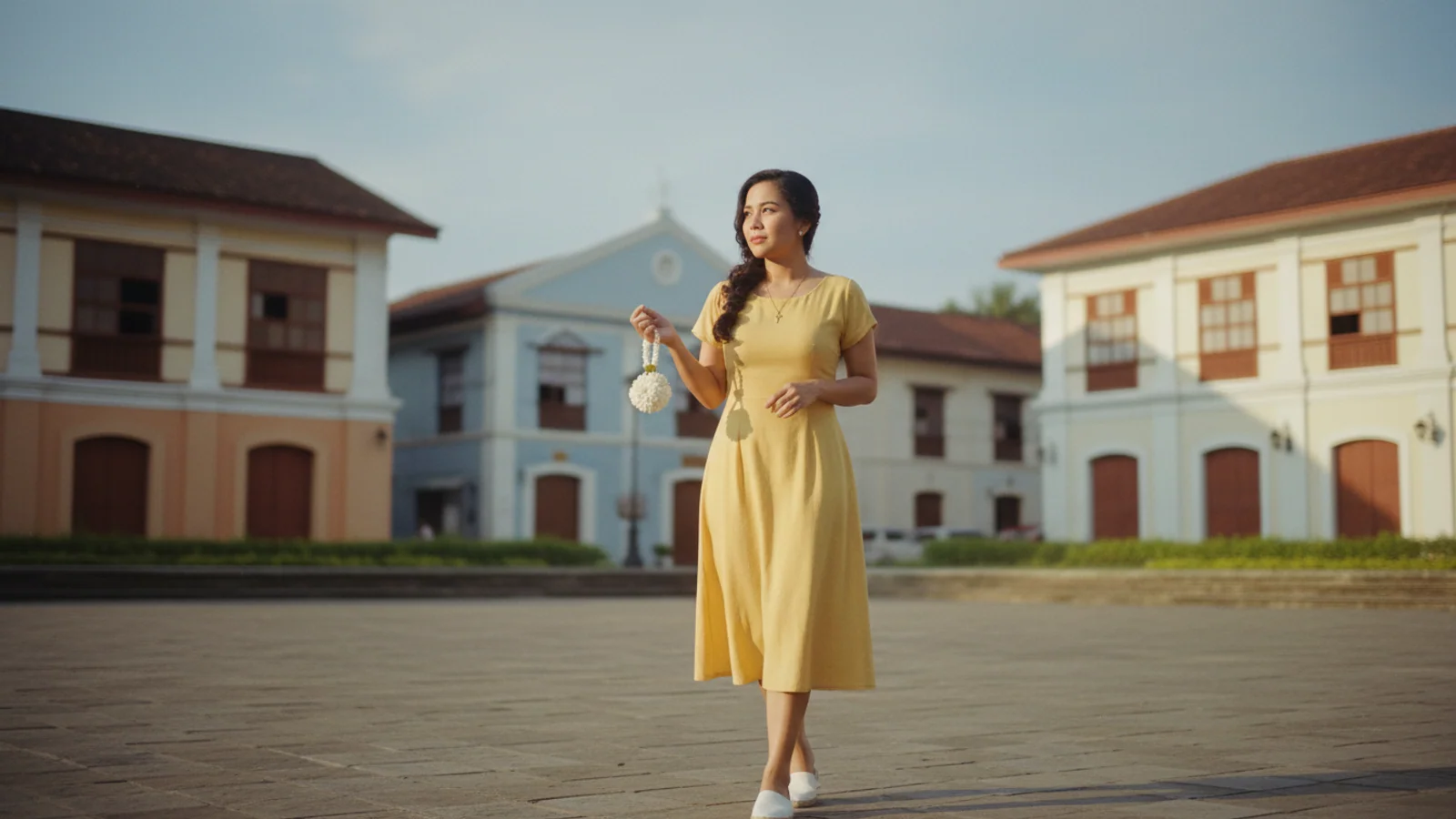
Most articles about Filipino dating culture flatten 100 million people into a single sentence about smiling women and Catholic values. The actual culture is richer, older, and more contradictory than that. You can find women in Manila using Bumble Premium and women in Bicol whose grandfathers still sang outside the bedroom window. Both are Filipino. Both are dating in 2026.
This is the cultural companion to our foreigner’s guide to dating in the Philippines, which covers visas, cities, and platforms. This one goes deeper on the customs: ligaw, harana, pamamanhikan, hiya, utang na loob, padala, the debut, the entourage wedding, and how Gen Z Filipinas are quietly rewriting all of it on their phones. If you are evaluating platforms, see the best Filipino dating sites and reviews of FilipinoCupid and Cherry Blossoms.
Ligaw: The Formal Courtship Tradition
The Tagalog word ligaw (or “panliligaw”) translates roughly as “to court,” but the word carries weight the English equivalent does not. Ligaw is not a date. It is a process that classically stretched over months before any formal commitment.
The traditional script: a young man developed feelings for a young woman in his barangay (village). He could not simply ask her out. He visited her family home, often with an older male relative present, and made his interest known to her parents before he made it known to her directly. If they welcomed him, the visits continued. He helped around the house, chopped firewood, fetched water, ran errands for her mother. This was called “paninilbihan,” or service to the family.
The woman was expected to be slow. Accepting too quickly was read as low value or loose virtue. “Mahirap ligawan” (hard to court) was a compliment.
What Persists in 2026
Almost no urban Filipina expects literal firewood-chopping in 2026. What persists is structural, not theatrical:
- Pace. Filipinas accept relationships more slowly than Western norms suggest. Three weeks of consistent interest is closer to the floor than the ceiling.
- Family awareness. She will tell her mother or sister about you within the first weeks. Your name and country circulate through her family network long before you meet anyone.
- The man initiates. The cultural default still places initiative on the man. Women who pursue actively risk being read as forward.
- Indirect signaling. Yes does not always mean yes the first time. Interested Filipinas may decline a first invitation because accepting too quickly feels wrong. The right move is to ask twice without pressure.
Sociologist Belen Medina, in The Filipino Family, documents how these patterns persisted through urbanization, migration, and television. The vehicle changed; the expectations did not.
The full traditional ligaw still exists in rural Luzon, parts of the Visayas, and the Cordilleras. If you meet a woman from a province, expect her parents to be more involved than her Manila-raised cousin’s would be: slower pace, chaperone-style group hangouts, and an earlier expectation that you will visit her town. In Manila, Cebu, and Davao, ligaw has been compressed into something closer to what Westerners call “the talking stage,” but with three Filipino fingerprints: family is told earlier, pace is slower, and clear intentions arrive sooner.
Harana: The Serenade, Past and Present
If ligaw was the script, harana was the centerpiece. Harana is the tradition of a young man, often with friends or musicians, standing outside a woman’s home at night and singing to her with a guitar. The setting was the dirt yard or the bottom of the stairs of her elevated nipa house. If she liked him she opened the window and listened. If she liked him enough she invited him up.
Harana traces back to the Spanish colonial period and combines Spanish musical forms (kundiman ballads) with pre-colonial Filipino courtship practices that were already family-mediated and public. By the American era it was universal across Tagalog provinces, the Visayas, and Bicol.
The tradition faded for prosaic reasons. Urban houses do not have windows on dirt yards. Cell phones replaced the need to show up. Neighbors complain about midnight guitars in concrete subdivisions. By the early 2000s harana was a nostalgia item, alive in film and at cultural festivals but no longer how anyone actually courted.
The Contemporary Echo
What replaced harana never replaced its function: a public, costly, romantic declaration the whole neighborhood saw. The contemporary equivalents are smaller. Videoke song dedications still happen in nearly every Filipino household. Filipinas of all ages send “hugot” songs in voice messages, songs that pull something from inside. Gen Z receives public TikTok and Reels dedications from interested men. A foreigner who can play a Filipino love song or a Western ballad with an acoustic guitar at a family birthday is performing the modern harana.
Knowing harana existed matters more than trying to recreate it. The underlying value, romantic effort that is publicly seen, has not gone away.
The Catholic Frame and Filipina Sexuality
The Philippines is, by Pew Research, about 79 percent Catholic, 11 percent other Christian (Iglesia ni Cristo, born-again, various Protestant), 5 percent Muslim concentrated in Mindanao, with a small balance of indigenous, Buddhist (in Chinese-Filipino communities), and non-religious.
Catholicism shapes dating in three concrete ways foreigners often miss.
Mass is social. Sunday Mass at the local parish is not just religious obligation. It is a weekly social event where families are seen and where a Filipina who attends with you is making a quiet public statement. Joining her at her family’s parish is a higher-trust act than dinner at a nice restaurant.
The 1987 Constitution, in Article XV, recognizes the family as “the foundation of the nation” and marriage as “an inviolable social institution.” Divorce remains illegal for non-Muslim Filipinos at the time of writing. Annulment exists but it is slow, expensive, and theologically reframed as a declaration the marriage was never valid. The legal architecture treats marriage as nearly permanent, which pushes Filipinas toward longer evaluation before saying yes.
Purity values are real but more nuanced than the stereotype. The cultural script is more sexually conservative than Western Europe and considerably more conservative than urban Thailand. But Filipina sexuality is not a monolith. Surveys reported in Filipino media have consistently shown that premarital sex is widespread among Filipinas in their twenties and thirties, particularly in urban areas. What differs from the West is the privacy around it. A Filipina may have an active sex life that her parents do not know about and that she will not casually discuss on a first date. The conservatism is more about social presentation than actual behavior. Reading her as either a virgin who needs protecting or a worldly partner ready for explicit conversation can both be wrong. Treat her as the individual she is, not as the script you expected.
Pamamanhikan: Asking the Parents
Pamamanhikan is the formal visit by the man, often with his own parents, to the woman’s family home to ask for her hand in marriage. The word comes from “panhik,” to climb up, referring to the stairs of the traditional elevated Filipino house. In its full form it was a one-day ceremonial visit that turned into a negotiation: who pays for the wedding, whether the couple lives with her parents or his, the wedding sponsors, and the date. In 2026, urban pamamanhikan is compressed but the core remains.
What to Expect as a Foreigner
You arrive in the late afternoon, ideally for dinner. Long pants, collared shirt, leather shoes if you have them. Shorts are wrong even in 35-degree humidity. Bring food: a lechon for larger gatherings, a cake from Red Ribbon or Goldilocks, a basket of fruit, or pasalubong from your country. Flowers are wrong unless someone has died.
Greet her parents using “po” and “opo,” the respectful particles. “Magandang gabi po” goes a long way. Touch the back of the older woman’s hand to your forehead in a gesture called “mano po” if you can.
You sit. You eat what is offered. The mother will serve significantly more food than you can finish. Take some, eat slowly, compliment the cooking. Refusing food outright reads as rejection of the household. Conversation starts with small talk: your work, your country, your family. The father will likely ask about your plans. The mother says less and listens more. Her assessment is the one that matters.
State your intentions cleanly: “I love your daughter, I want to marry her, and I am here to ask for your blessing.” Use English; everyone will follow. Her father will likely give a small speech in response. Thank him. Thank her mother separately, because her mother did the real evaluating.
After pamamanhikan, the engagement is real. Calling it off becomes a family-level event, not a private decision. This is exactly why pamamanhikan happens before, not after, wedding logistics start.
Family Centrality, Utang na Loob, and Padala
You cannot understand Filipino dating without understanding the family. Belen Medina’s The Filipino Family treats it as the central organizing unit of Filipino social life, much more than the individual.
Utang na Loob
Utang na loob translates literally as “debt of the inside.” It is the lifelong obligation a person feels toward someone who has helped them, especially parents. Unlike a money debt, utang na loob is not paid off. It is honored continuously. A daughter does not stop owing her parents because she handed them a year of her salary.
This shows up in dating in concrete ways. Filipinas who can support their parents do, even when the parents do not strictly need it. Daughters often feel more obligation than sons. A serious foreign partner inherits a portion of that obligation by association. You did not sign up for it directly, but you are in proximity to it, and how you respond reveals who you are.
Padala and Family Financial Expectations
Padala is the everyday word for sending something to family. In dating context it almost always means remittance.
According to the Bangko Sentral ng Pilipinas, cash remittances from OFWs consistently exceed 30 billion US dollars annually, one of the largest remittance flows in the world relative to GDP. Sending money home is the modal experience of Filipinos with overseas-working relatives, and most families have at least one.
For a Filipina dating a foreigner, padala is normal. She has been sending money home since her first job and she will continue. The conversation worth having is what happens when shared finances start and whether her family’s expectations expand because she is connected to you.
When It Is Culture and When It Is Exploitation
Most padala is cultural. A Filipina sending her mother 5,000 to 8,000 pesos a month from her own salary is doing what virtually all working-age daughters of her generation do. Resisting that as a foreign partner is asking her to break a value she has held her entire life.
A small minority of situations cross into exploitation. The patterns are not subtle: open-ended escalating requests without a stated purpose, family emergencies on a suspicious schedule, direct contact from her relatives asking you for money before you have met them, pressure that increases with your demonstrated wealth.
A useful approach: agree on a fixed monthly support amount, send it on the same day every month, and treat additional requests as discussions rather than automatic transfers. This converts an open-ended expectation into a structured one without rejecting the underlying value.
Hiya: Shame, Saving Face, and What Foreigners Misread
Hiya is usually translated as “shame,” but the translation undersells it. Hiya is closer to social propriety combined with fear of losing face. Sociologist Niels Mulder, referenced in Journal of Southeast Asian Studies, and Filipino scholar F. Landa Jocano wrote extensively on hiya as one of the core cultural values structuring Filipino social behavior.
A Filipina with hiya will not directly contradict you in public, will not reject a request that would embarrass the asker, and will not openly disagree with her parents in front of guests. She avoids saying no when “let me think about it” is socially smoother.
Foreigners misread this as evasiveness or passive aggression. It is neither. It is a different conversational norm. The honest conversation happens in private with someone she trusts. Pushing for directness in front of others asks her to violate a value she did not consciously choose.
The right move is to create private space for the real conversation. If she said yes in front of her sister but seems hesitant, give her an opening when you are alone: “Are you actually okay with this?” Privacy unlocks directness. Without it, she will say yes and quietly resent the situation.
Hiya also explains why Filipinas often prefer slow fade-outs to breakup conversations. If you sense she is fading, the kind move is to say it yourself.
Religion Beyond Catholic Majority
Catholicism dominates, but the Philippines is religiously more diverse than the headline number suggests.
Iglesia ni Cristo (INC). A Filipino-founded Christian denomination established in 1914. Members attend services twice a week, follow specific moral codes, and marry other INC members. A foreigner in a serious relationship with an INC member typically faces a binary choice: convert through months of doctrinal study, or accept the relationship will not lead to a sanctioned marriage.
Born-again and evangelical Christians. Expanded since the 1980s with congregations like Jesus Is Lord, Christ’s Commission Fellowship, and Victory. More flexible on inter-denominational marriage than INC, more conservative than Catholic Filipinas on cohabitation, alcohol, and church attendance. A born-again Filipina will likely expect a Christian partner who attends church with her.
Muslim Mindanao. Around 5 percent of Filipinos are Muslim, concentrated in the Bangsamoro Autonomous Region and adjacent provinces. Romantic relationships are typically not publicly acknowledged before a formal engagement. The man is often expected to convert to Islam for marriage. Family involvement is even stronger than in the Catholic majority. This is a culturally distinct context, not a regional variation.
Indigenous folk overlay. Across all denominations a layer of indigenous folk belief persists. Spirits, faith healers (arbularyo), and superstitions about marriage timing (avoiding weddings in May, sukob taboos around siblings marrying the same year) are widespread even among devout Catholics. Dismissing these as backward misses a layer her grandmother holds strongly. The polite response is curiosity, not correction.
Kasal, the Entourage Wedding, and Padrino Madrina
A Filipino wedding (kasal) is structurally larger than most Western weddings. The wedding party (the “entourage”) includes formal sponsor roles with specific meanings.
Principal sponsors (ninong and ninang) are older married couples chosen for their respect, influence, and willingness to mentor the marriage. Filipino weddings often have many of them, sometimes a dozen on each side. Secondary sponsors are younger and handle specific symbolic acts: lighting candles, draping the veil, tying the cord. The coin bearer carries the “arrhae” (thirteen coins) symbolizing the groom’s commitment to provide.
For a foreigner marrying a Filipina, the entourage feels overwhelming. Your partner is not over-staffing the wedding. She is honoring people who matter to her family. Trying to slim it down tends to insult exactly the people the marriage needs to land well with.
The civil ceremony and the church wedding are often separate events. Civil is legally binding and held at city hall. The church ceremony is the social wedding with the entourage and reception.
The Debut
Filipina culture has a strong debut tradition for women turning 18. The debut is a major party, often as elaborate as a small wedding, with a formal program, a cotillion of dancers, eighteen roses presented by eighteen men, eighteen candles lit by eighteen women, and a ball gown. The men in her life each give her a rose and dance one number. Her female mentors light a candle and give a piece of advice with each. For a foreigner dating a Filipina who has a younger sister or daughter approaching 18, you will be invited. Being asked to give one of the eighteen roses is a real honor.
Regional Differences
The Philippines is not one culture. Major regional groupings vary in language, food, courtship pace, and family structure.
Tagalog (Luzon including Metro Manila). The largest ethnolinguistic group and the cultural reference point of Filipino media. Source of most “default” traditions described above.
Visayan (Cebu, Iloilo, Bohol). Warmer informality, different humor, Cebuano (Bisaya) as dominant language. Visayan Filipinas often describe themselves as more direct than their Tagalog counterparts. A foreigner who learns basic Bisaya rather than Tagalog when dating a woman from Cebu signals real respect.
Bicolano (Bicol region). Food-centered (spicy coconut-based cuisine), strongly Catholic. Family involvement is even stronger than the national average. Many Bicolanas work as OFWs and family-led dating decisions persist across thousands of miles.
Ilocano (northern Luzon). Stereotyped within the Philippines as careful with money, hardworking, and reserved. Ilocano Filipinas are often described as serious-minded and slower to open emotionally. Reductive, but reflects a real strain of frugality.
Chinese-Filipino. Small but economically influential community across Manila, Cebu, and other urban centers. Traditions blend Hokkien Chinese, Catholic, and Filipino elements. Dating often involves additional considerations around family approval and traditional Chinese elements layered on top of Filipino ones.
The OFW Reality
Most Filipino families have a relative working abroad. The PSA Survey on Overseas Filipinos estimates the OFW population at 1.8 to 2.2 million. Saudi Arabia, the UAE, Hong Kong, Singapore, and Japan are major destinations.
Long distance is normal. Filipinas grow up watching relatives live abroad for years. A foreigner who can sustain consistent long-distance communication is matching a pattern Filipinas already understand.
The breadwinner role is often female. Many OFWs supporting families back home are women, particularly nurses and domestic workers. The image of the Filipina as a sheltered dependent does not match a generation of women who have personally funded their parents’ retirement, their siblings’ college, and their nieces’ weddings.
Balikbayan reunions are major events. Returning OFWs are “balikbayan” (back to country). When they come home around Christmas, the family gathers and gifts are distributed. A foreigner visiting during a balikbayan period meets the family in a warm but crowded context.
Modernization: Gen Z, Dating Apps, and the Shift From Formal Ligaw
Filipinas dating in 2026 are a different generation from the ones in the courtship literature of the 1980s. Smartphones arrived early. Facebook penetration is near-saturation. The Philippines is consistently among the top global markets for social media use per capita.
First meetings usually happen digitally. The “she sees you at church or a barrio dance” path has been replaced by Tinder, Bumble, FilipinoCupid, and similar platforms. Urban Filipinas meet partners primarily through apps, with church and workplace as offline backups.
The pace compressed but did not collapse. Where ligaw once spanned months of visits, modern Filipinas may move from match to in-person date in a week, yet still expect the man to lead, loop family in early, and offer a clear declaration of intent within weeks. Family approval still matters even if the path changed. A Filipina who introduces you to her mother over a WhatsApp video call before you have met in person is doing the modern equivalent of inviting you for a house visit.
The performative public gesture has moved to social media. Gen Z Filipino couples post anniversary tributes, monthsaries (monthly anniversaries are a real thing), and proposal videos. Public posting of the relationship is often the signal that it is officially official.
The values underneath have not changed. Filipinas using Bumble in BGC still feel utang na loob, struggle with hiya, and expect pamamanhikan if marriage is on the table. The tools changed. The architecture did not.
How to Use This in Your Own Dating
Your relationship is with her and her family. Treating it as a relationship with her alone is a category error. The family is in it whether you acknowledge them or not.
Slow down. Filipino courtship pace is slower than Western defaults. Acceleration reads as pressure. Patience reads as respect.
Be direct in private, not in public. Hiya means real conversations happen one-on-one. Pushing for directness in front of family gets you the answer she had to give, not the one she believes.
Money is cultural. Decide upfront, with her, what role family support will play, and treat it as a structural element rather than a recurring crisis.
Respect the religion. Whether Catholic, INC, born-again, or Muslim, her framework shapes how she dates, how she marries, and how she raises children.
For visas and meeting strategies, see the foreigner’s guide to dating in the Philippines. For platforms, see the best Filipino dating sites, or for religion-filtered matching, Christian Filipina. The major secular platforms with long track records are FilipinoCupid and Cherry Blossoms.
Done right, dating across this culture is not a series of foreign customs to perform. It is a slower, more family-centered version of what dating already is everywhere: paying attention to another person, taking their world seriously, and being someone worth taking seriously back.